The Philosophy
A system for understanding how the mind holds, loses, and restores coherence under pressure
The Master’s Wheel begins with a simple premise: clarity is not a personality trait — it is a cognitive architecture. Human judgment is shaped by two inseparable layers: the brain’s biological limits and the mind’s narrative structures. Under pressure, these layers interact, distort, compress, and sometimes fail. The philosophy behind The Master’s Wheel maps these distortions, the patterns of collapse they produce, and the pathways back to coherence.
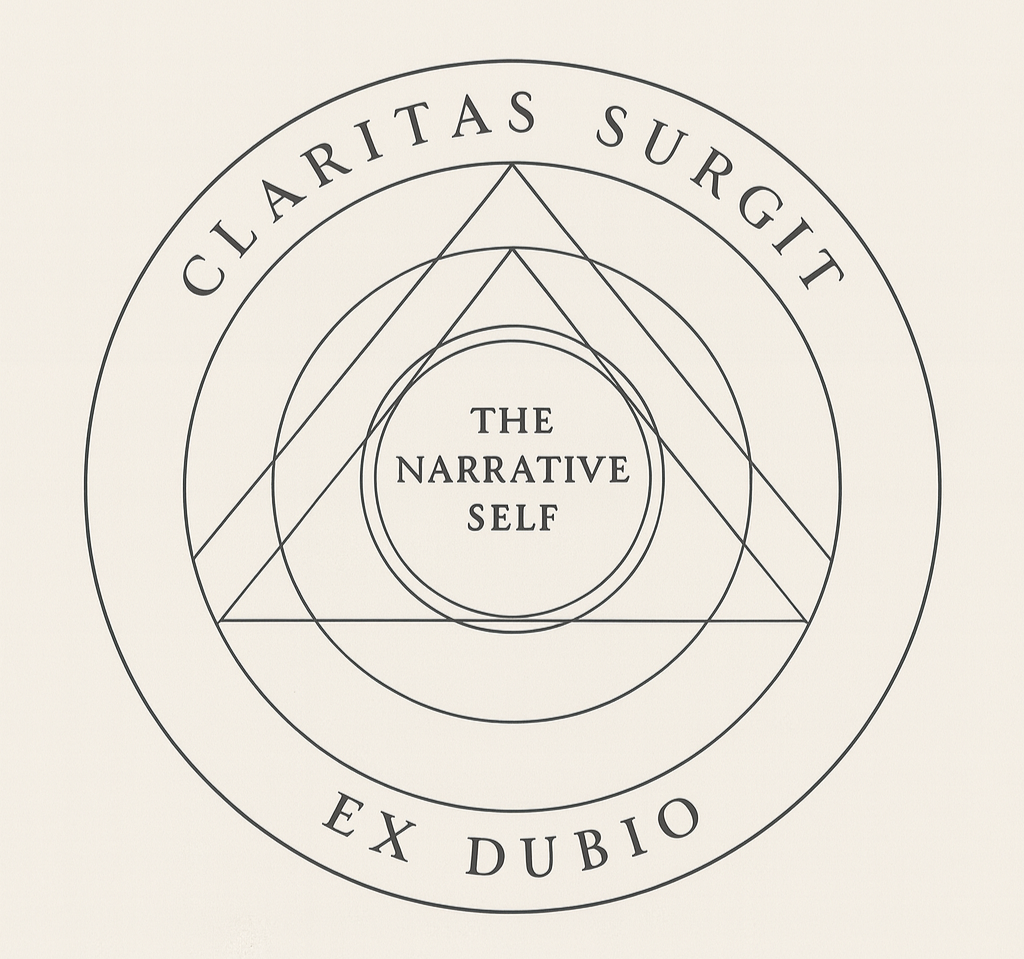
A modern training circle, inspired by the Destreza tradition, framing clarity, doubt, and the narrative self.
“Claritas Surgit Ex Dubio.”
“Clarity arises from doubt.”
-Ethos of The Master’s Wheel

Foundational Axiom
The Cognitive Architecture Principle
Human cognition is built on two intertwined systems: the hardware of neurobiology and the software of narrative. Modern psychology overwhelmingly concentrates on the hardware—mapping circuits, biases, and behaviors—while largely neglecting the narrative structures through which human beings interpret meaning, maintain identity, and navigate uncertainty.
Narrative is the native language of cognition — the brain’s integrative system for compressing complexity, predicting outcomes, and preserving coherence when neural resources are depleted.
Under cognitive load, working memory collapses and narrative simplifies, pulling the person into older scripts that require less bandwidth. Understanding this interplay between mechanism and meaning is the center of The Master’s Wheel; every other principle radiates from it.
Core Principles of The Master’s Wheel
Narrative Reversion
Under cognitive strain, the mind falls back to earlier internal roles and scripts — not out of choice, but as the fastest route to coherence. You do not rise to the occasion; you revert to your training and your oldest stories.
Collapse Through Contradiction
Collapse is not chaos; it is contradiction realized. When a person’s internal narrative cannot absorb the demands of a moment, coherence fractures. Confusion, becoming overwhelmed, and disorientation are not moral failures — they are lived consequences of narrative strain.
Narrative Preservation
Humans protect their internal story even at the expense of accuracy, procedure, or transparency. This is not deception — it is existential preservation. When truth threatens identity, narrative becomes motive.
The Villain Bias
Under uncertainty, the mind demands simplicity. It seeks antagonists and linear causes. Complexity collapses into binary explanations — even when reality is multi-directional, ambiguous, or emergent.
Fracture Incoherence
When coherence breaks, narrative breaks with it. Language fragments, timelines slip, identity oscillates. These patterns are the cognitive signatures of collapse — and they can be diagnosed.
Story, Template, and Identity
Story as a Situational Identity Model
Story is not entertainment — it is the architecture of the self. A “story” is the brain’s way of organizing identity within a situation: who I am, what this means, what I’m allowed to do, and what must be defended. Stories create behavioral limits long before logic does.
Template as Structured Expectation
A template is the mind’s pre-loaded map of how events should unfold. When reality diverges from the template, contradiction arises — and contradiction is the birthplace of drift, collapse, and reversion.
Clarity as a Trained Discipline
Clarity is not achieved by suppressing emotion, removing uncertainty, or forcing certainty. It emerges from training the internal architecture that interprets uncertainty in the first place. The Master’s Wheel develops this through two intertwined modes:
Real-Time Diagnostics — detecting drift, contradiction, and collapse as they form.
Forensic Diagnostics — reconstructing what failed and why, without shame, guilt, or narrative bias.
The result is a disciplined mind capable of navigating pressure without narrative distortion.
From Understanding to Practice
Clarity is not an inherent trait. It is not confidence, speed, or certainty. It is a trained capacity — cultivated through disciplined attention, narrative restraint, and ethical reasoning under pressure.
The Master’s Wheel is not an ideology to adopt or a checklist to memorize. It is a disciplined way of seeing—grounded in clear axioms about cognition, narrative, and collapse—that reveals itself through practice. Its claims are not accepted on faith, but tested under pressure: in moments where certainty fails, narratives harden, and identity begins to steer action before reasoning is complete.
This work is for those willing to slow down where others rush, to examine contradiction rather than resolve it prematurely, and to treat clarity not as an outcome to claim, but as a responsibility to earn.
If this language resonates, the work continues.