Origins
Geometry, reason, and the governance of the self under pressure
La Verdadera Destreza—the Spanish Renaissance tradition known as the “true art” of the sword—was not merely a system of fencing, but a disciplined philosophy of judgment under pressure.
Grounded in geometry, proportion, and rational control of the passions, its masters understood combat as a test of cognition as much as technique. Reason was meant to govern impulse; clarity was cultivated through structure; and composure was treated as a trained capacity rather than a personality trait. The Master’s Wheel draws from this intellectual lineage—not as historical reconstruction, but as continuation—extending Destreza’s philosophical commitment to clarity into the modern terrain of decision-making, collapse, and human behavior under stress.
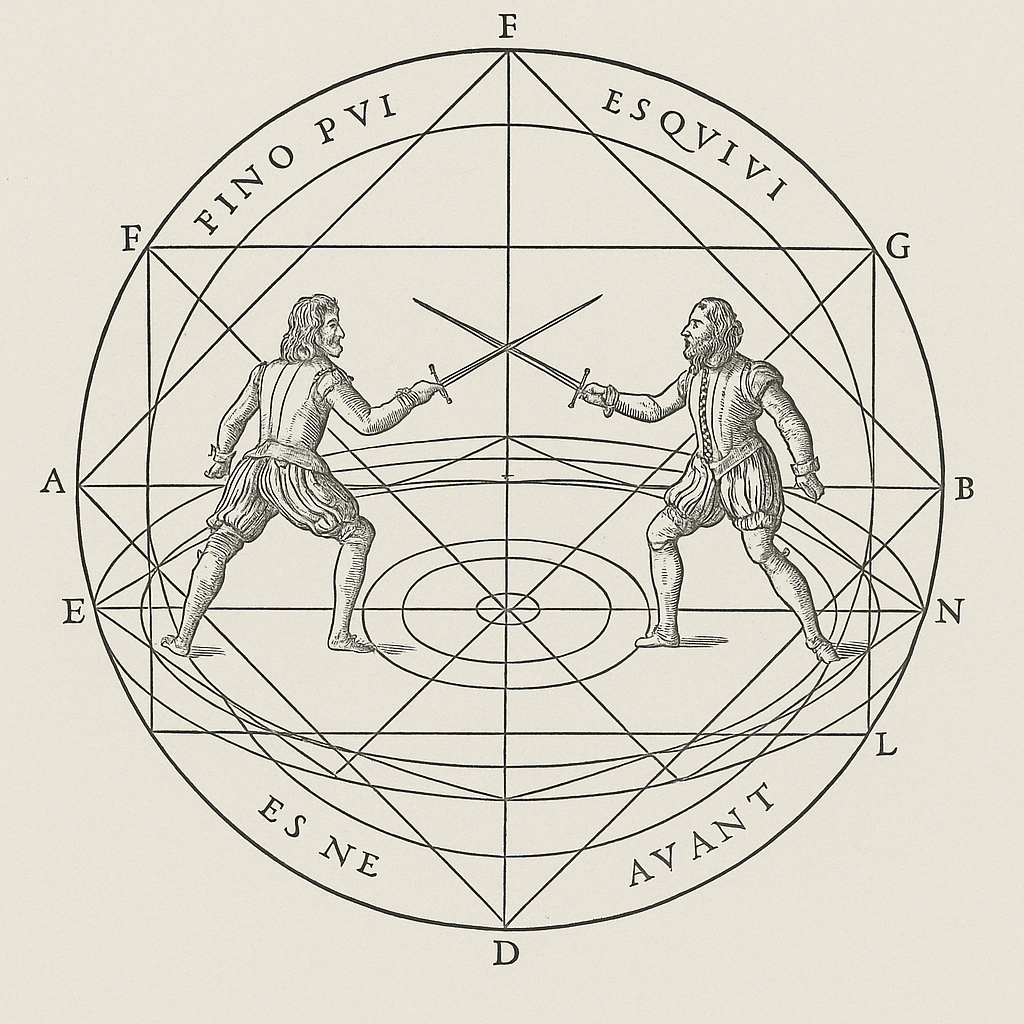
Thibault’s circle — one of the classical geometric foundations of La Verdadera Destreza
Thibault’s maxim does not describe retreat or avoidance, but a disciplined relationship to pressure. In La Verdadera Destreza, evasion was not withdrawal—it was positional intelligence. One advanced by refusing to meet force with force, certainty with certainty. Instead, the practitioner maintained structure, distance, and proportion, allowing error and overcommitment to reveal themselves. Progress came not from domination, but from restraint.
The Master’s Wheel carries this principle forward as a cognitive discipline. Under stress, the mind seeks certainty and closure—but these impulses often create collapse rather than preventing it. The Master’s Wheel trains a different posture: to remain structured within ambiguity, to move forward by resisting premature narrative commitment, and to let contradictions surface rather than be resolved too quickly. In both fencing and cognition, mastery is not found in direct confrontation, but in disciplined positioning within uncertainty.
“Fino Pui Esquivi Es Ne Avant”
“Mastery lies in advancing through evasion.”
-Gérard Thibault, Académie de l’Espée

From Sword to Mind
La Verdadera Destreza was not merely a fencing system, but a rational discipline rooted in geometry, ethics, and restraint. Gérard Thibault’s circular diagrams were not decorative abstractions; they were diagnostic instruments. The circle defined distance, angle, timing, and proportion — and, in doing so, revealed when an action was safe, unstable, or doomed before contact was ever made.
The Master’s Wheel inherits this logic directly. Where Destreza used geometry to govern movement under threat, The Master’s Wheel uses structure to govern cognition under pressure. In both systems, failure is rarely sudden. It emerges when the practitioner violates proportion, ignores contradiction, or advances without control.
The weapon has changed. The discipline has not.
Geometry as Diagnosis
In Destreza, the circle was not just a place — it was a framework for seeing. Every position within it carried information: what can be defended, what cannot, what risks compound, and what movements are illusions of safety. The circle reveals error not after a strike, but before it is made.
The Master’s Wheel applies this same diagnostic principle to reasoning itself.
By mapping narrative position, motive, assumption, and pressure, the framework exposes cognitive imbalance early — before decisions harden, narratives collapse, or systems fracture. Just as the Destreza practitioner learned to recognize unsafe angles instinctively, practitioners of The Master’s Wheel learn to recognize contradiction before it becomes consequence.
And when failure has already occurred, the same geometry functions in reverse.
Post-event, The Master’s Wheel becomes a forensic instrument — tracing collapse backward through pressure, narrative drift, and missed inflection points. What was unseen in motion becomes visible in retrospect. The geometry still holds.
This is not merely analysis after failure. It is perception before commitment — and diagnosis after collapse.
Evasion as Advancement
“Fino Pui Esquivi Es Ne Avant” is not a paradox in the Destreza tradition — it is a discipline. True advancement does not come through brute forward motion, but through disciplined deviation: stepping offline, yielding space, and preserving structural integrity while the opponent commits to overextension.
In this sense, mastery lies not in speed, but in discernment and measured action.
The Master’s Wheel applies the same principle cognitively.
Progress under uncertainty does not arise from forcing clarity, collapsing ambiguity, or racing toward premature conclusions. It emerges from resisting narrative pressure, recognizing instability, and advancing only when alignment, evidence, and structure genuinely permit it. What appears from the outside as hesitation is, in reality, controlled movement within a complex field — the mental equivalent of stepping off the line to see more clearly.
This is not passivity. It is intentional positioning — the art of advancing by refusing to be rushed.
From Technique to Discipline
Historically, Destreza distinguished itself from other fencing systems by insisting that technique without ethical discipline was incomplete. Skill divorced from restraint produced bravado, not mastery. True proficiency required training perception, judgment, and self-regulation under threat.
The Master’s Wheel makes the same claim — explicitly.
This is not a toolkit, a mindset, or a performance method. It is a discipline of thinking under stress. It integrates diagnostic reasoning, ethical constraint, narrative skepticism, and embodied awareness into a coherent practice. The goal is not persuasion, dominance, or certainty — but clarity earned through resistance to cognitive collapse.
In both systems, the practitioner is the instrument. Training does not optimize outcomes; it reshapes how pressure is metabolized.
The Master’s Wheel as Continuation, Not Metaphor
The Master’s Wheel is not inspired by La Verdadera Destreza in name alone. It continues the same epistemic stance: that structure precedes action, that error reveals itself early to the trained observer, and that restraint is a form of intelligence.
Where Destreza placed the body within geometry, The Master’s Wheel places the mind within narrative structure. Where Destreza trained survival under steel, The Master’s Wheel trains clarity under consequence.
The circle remains — not as ornament, but as discipline.